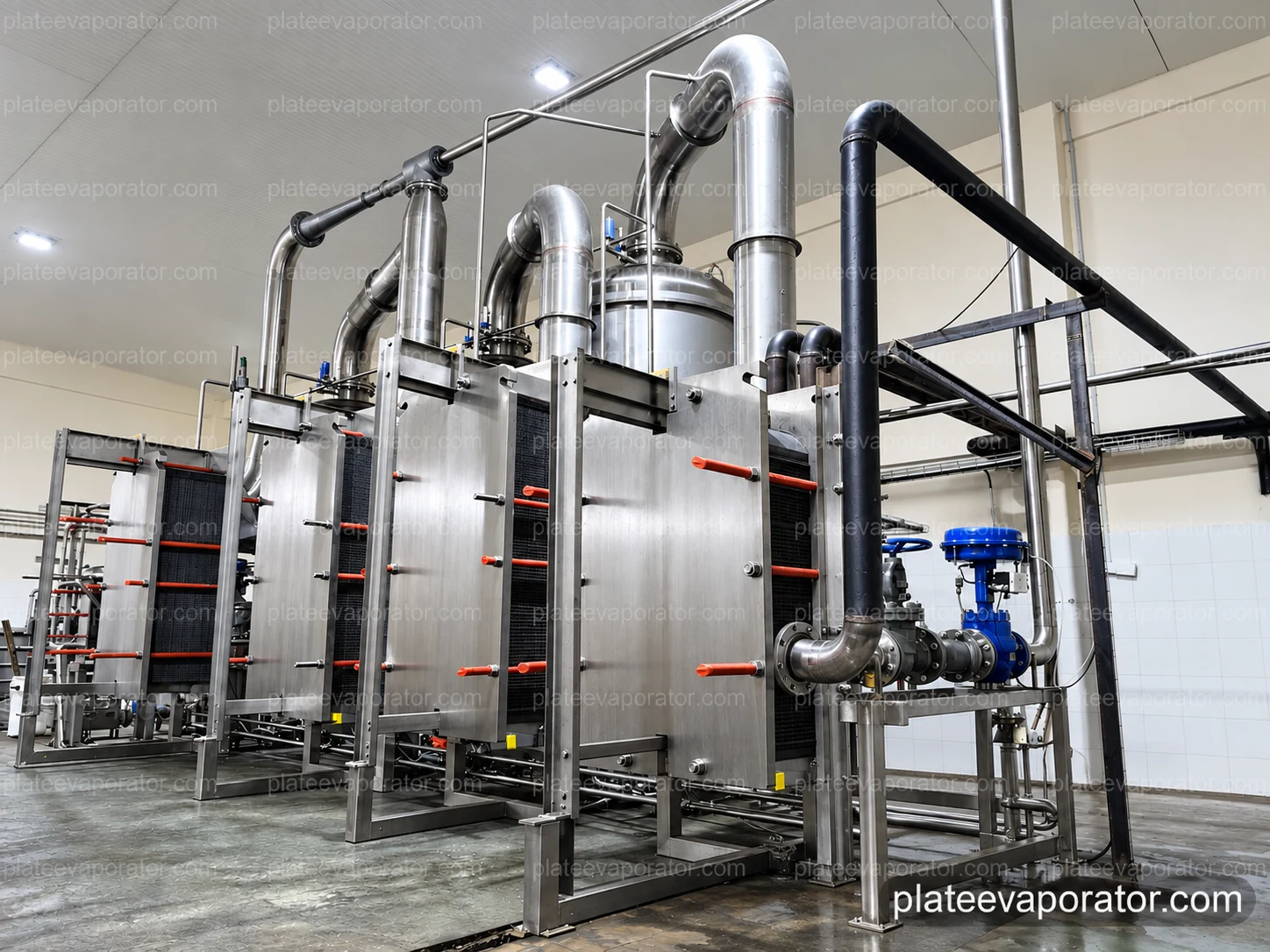
Reuse secondary vapour between effects
Each effect needs enough temperature difference to transfer heat to its liquid. Successive pressures and boiling conditions allow generated vapour to provide heating in another effect. The plate assemblies, separation vessels and interstage piping therefore function as a coordinated thermal system.
More effects divide the available thermal window into more stages. Product boiling-point behaviour, heat-transfer performance and deposits can reduce the usable difference. The right effect count is a design decision, not a universal rule that more is always better.
Compare the operating envelope
Evaluate the water-removal duty across the expected production range, including low-feed conditions and product changes. The liquid becomes more concentrated through the process, so pumping and heat transfer must work at the outlet as well as at the inlet.
Compare heating, cooling, installed scope and cleaning needs on the same feed and output basis. Project-specific energy consumption should be part of the quotation or duty calculation; it cannot be obtained from the number of effects alone.
| Configuration | Decision to investigate |
|---|---|
| Double effect | Two connected effects within the available thermal window |
| Three effect | Three stages with coordinated pressure, transfer and separation |
| TVR-assisted effects | Motive-steam conditions and recovery alongside the selected effect count |
Use actual installations as configuration references
Two coconut water projects show three-effect plate equipment in service settings. The Indonesian record reports 6,000 L/h of water-removal duty. The Philippine record reports 4,000 L/h of feed and 3,700 L/h of water removal with TVR. These quantities describe their respective projects.
For a new liquid, recalculate the mass and heat balances. Confirm the permitted thermal exposure, concentrate viscosity, cleaning interval and utility supply before assigning an evaporation rating.