Calculate on a mass basis
Let F be the feed mass flow in kg/h, C the concentrate mass flow in kg/h, and xF and xC the mass fractions of the same conserved, non-volatile solids in the feed and concentrate. If those solids remain in the concentrate, F × xF = C × xC. Concentrate flow is therefore C = F × xF ÷ xC.
If water is the only other stream removed, the preliminary water-removal duty is W = F − C. The calculation excludes solids losses, entrained product, separate reject streams and changing inventory. Those terms are added to the actual process balance where they occur.
| Input or result | Unit or basis | Meaning |
|---|---|---|
| Feed F | kg/h | Product mass entering the defined evaporation boundary |
| Feed solids xF | Mass fraction or mass percentage | The conserved non-volatile solids in that feed |
| Target solids xC | The same solids basis as xF | Required concentration of those solids in the output |
| Concentrate C | kg/h | Calculated output under the stated assumptions |
| Water W | kg/h | Calculated water removal under the simplified balance |
An illustrative calculation, not a machine rating
Consider a hypothetical feed of 1,000 kg/h containing 5 mass% conserved non-volatile solids, concentrated to 20 mass% on the same basis. The incoming solids are 50 kg/h. The simplified balance gives 250 kg/h of concentrate and 750 kg/h of removed water.
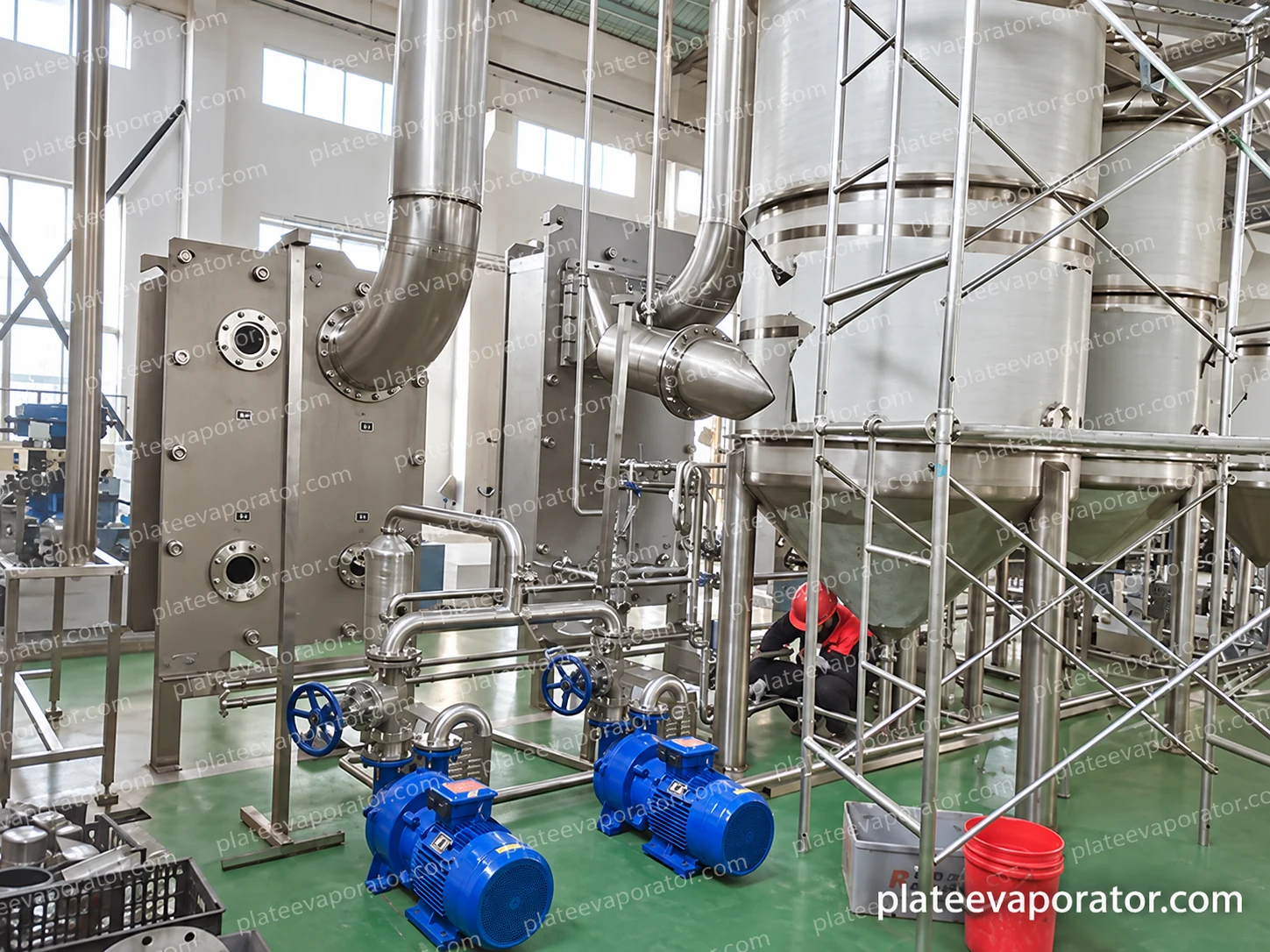
This example demonstrates arithmetic only. It does not describe either photographed project, set a plate-system capacity or predict heating and cooling demand. Product losses, volatile components, fouling and the selected thermal arrangement require separate assessment.
Do not substitute Brix or litres without checking the basis
Degrees Brix is a concentration scale associated with a sucrose solution. A refractometer reading from a real food liquid can be used as an apparent concentration measure, but it is not automatically the mass percentage of every non-volatile constituent. Product-specific composition and measurement methods determine how that reading can be used in a mass balance.
A flow in L/h also needs density at the relevant temperature and composition before conversion to kg/h. Feed and concentrate usually have different densities. Subtracting one volumetric rating from another does not establish concentrate volume, and a published water-removal rating is not the raw-liquid feed rate.
Check the material through the full concentration range
Viscosity, suspended material, foaming and deposit formation affect heat transfer and separation. The inlet condition alone is not enough: concentrate can become harder to distribute and pump as water leaves. Product thermal sensitivity and volatile components also influence acceptable operating conditions.
Plate passage and material selection follow the liquid and cleaning duty. The working range must allow the selected distribution or circulation arrangement to operate properly. Additional area or more effects cannot by themselves correct an unsuitable feed or a blocked cleaning path.
Translate the balance into an equipment and utility scope
The calculated water load is one input to the thermal design. Feed temperature, concentration-dependent boiling behaviour, heat recovery and the selected effects or TVR arrangement determine the heating and condensing duties. Site heating and cooling conditions must support those duties across the intended run.
The complete equipment scope includes the plate section, separation, feed and discharge handling, vacuum and condensation, instrumentation and cleaning connections. Upstream preparation and downstream filling can remain separate interfaces. A first enquiry can identify the liquid and intended equipment scope; detailed sizing follows as the project develops.
Optional local estimate
Estimate a mass balance
Use kg/h and mass percent of conserved, non-volatile solids. The starting values are an illustration, not a machine specification. Convert volumetric measurements using suitable densities before using this calculation; a Brix reading is not automatically an exact solids mass fraction for every food liquid.
This optional calculation runs in your browser and sends no information.
- Concentrated product
- Water removed
- Conserved solids
Assumes only water is removed and no solids are lost. The result does not size heat-transfer area, utility demand or a guaranteed production rate.
Further detail
Questions about the equipment
Can a plate evaporator be selected from feed flow alone?
Feed flow is one part of the duty. Feed and target concentration, product behaviour, operating temperature and the available utilities determine water removal and the equipment configuration.
Does a higher number of effects always make a better system?
More effects change heat reuse and the required pressure and temperature sequence. The useful arrangement depends on duty, product behaviour, utilities, operating range, space and cleaning requirements.
Does the preliminary balance predict product quality?
It estimates mass flows under stated assumptions. It does not predict aroma changes, thermal effects, fouling, cleaning performance or the condition required for the final package.