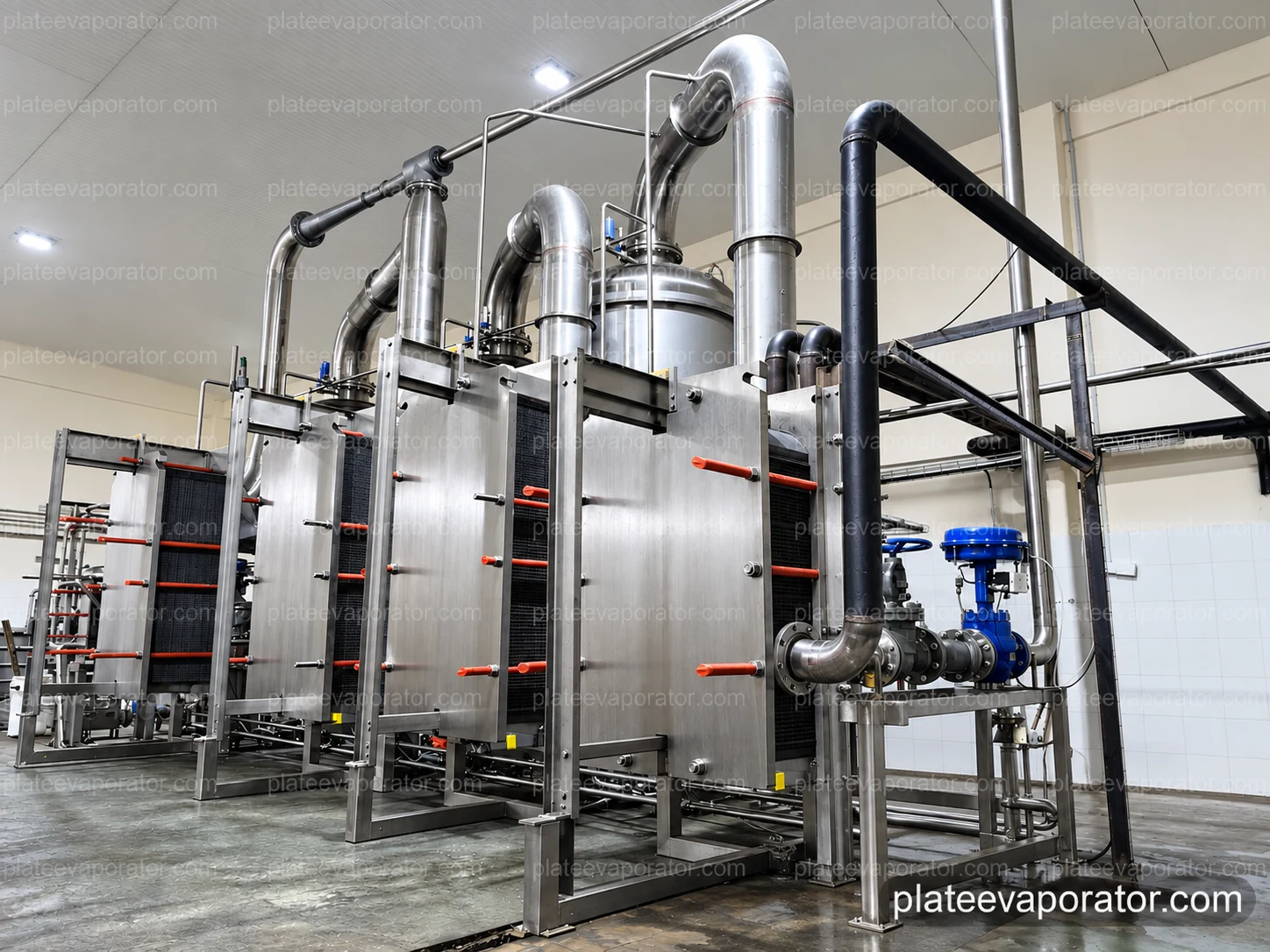
Effect count describes the connected evaporation stages
A single effect performs the evaporation duty within one thermal stage. A double- or multi-effect arrangement uses generated vapour from one stage as a heating source for another at a suitable lower pressure. Each stage still needs its own effective heat-transfer and separation conditions.
The available overall temperature difference is shared across the selected arrangement. Product boiling behaviour, heat-transfer resistance and operating pressure influence how it is allocated. Adding an effect is therefore an equipment and thermal-design change, not a universal percentage reduction in steam use.
| Configuration | Main design difference | What remains duty-specific |
|---|---|---|
| Single effect | One evaporation stage with its heating and condensing arrangement | Water load, surface area, vacuum and utilities |
| Double effect | Two coordinated evaporation stages with vapour reuse | Pressure sequence, interstage connections and working range |
| Multi-effect | Several coordinated stages and their service connections | Effect count, heat balance, product behaviour and installation |
TVR uses motive steam to recompress a vapour stream
A thermal vapour recompressor uses motive steam to entrain and raise the pressure of a selected vapour stream for a heating duty. The usable arrangement depends on the motive-steam condition, suction-vapour condition and required discharge condition.
TVR is supported by the documented three-effect coconut water installation in the Philippines. Its presence identifies an energy configuration, not a fixed saving for a different plant. The thermocompressor and associated connections must be selected with the evaporation duty and site steam supply.
Account for the heating and cooling sides together
Feed entering below its working temperature creates a preheating duty in addition to evaporation. Recovered heat can be included where the product and service conditions allow it. The final vapour load must also be condensed, and non-condensable gases must be handled by the vacuum arrangement.
Cooling-water inlet temperature, available flow, heating supply and condensate return affect the usable operating window. A nominal water-removal rating without these conditions cannot establish the utility consumption of a new installation.
Compare energy on a stated production basis
An energy comparison states the product, inlet and outlet concentrations, feed temperature, water-removal rate and measurement period. It distinguishes start-up from steady production and records relevant interruptions. Cleaning energy and the production time between cleaning cycles can matter to the overall result.
For a repeatable comparison, use the same boundary around each candidate system. Steam, electricity, cooling and recovered condensate belong to their respective services. This gives a practical basis for selecting the effect and TVR arrangement without assuming that compact equipment automatically has the lowest operating cost.
Further detail
Questions about the equipment
Are effect count and TVR the same specification?
No. Effect count identifies the evaporation stages. TVR identifies a steam-driven vapour-recompression arrangement that can be integrated with a selected system. Both need to be stated in the thermal and utility design.