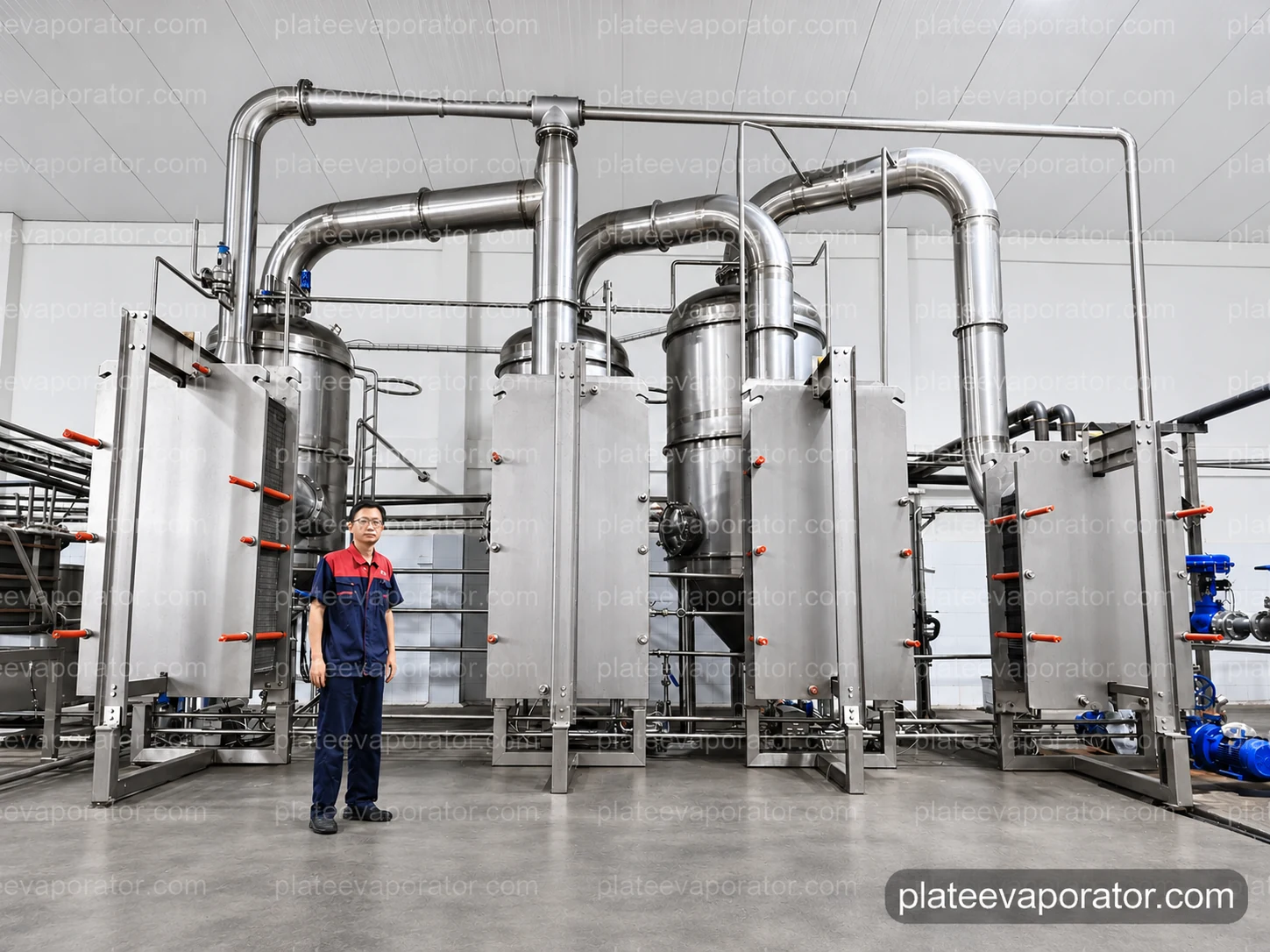
Three stages share the thermal duty
Secondary vapour from an earlier effect supplies a later heating duty as the operating pressure falls. Each stage combines plate heat transfer with separation and liquid handling. The temperature distribution must allow adequate heat transfer while respecting the product requirements.
Three-effect operation is not a specific machine capacity. Required area, feed distribution, product transfer and terminal condensation follow the actual liquid, concentration change and heating conditions.
Two projects, different reported quantities
The Indonesian coconut water project combines upstream three-phase separation with three-effect plate evaporation. Its reported 6,000 L/h rating is evaporation water removal, not incoming feed.
The Philippine three-effect project includes TVR. Its record gives 4,000 L/h of coconut water feed, 3,700 L/h of evaporation duty and a target from 4 to 60 Brix. Do not subtract the two volume figures to infer concentrate flow; feed and concentrate densities differ.
| Project reference | Configuration | Reported basis |
|---|---|---|
| Indonesia | Three effects with upstream phase separation | 6,000 L/h water removal |
| Philippines | Three effects with TVR | 4,000 L/h feed; 3,700 L/h water removal |
Define what a new installation must achieve
Start with a consistent mass balance, then establish the permissible boiling range, utility supply and run schedule. Product-specific viscosity, foaming and deposit formation can change how the effects should operate and be cleaned.
A quotation should identify the feed, concentrate and water-removal basis separately. Ask for the included package, terminal vapour handling, control functions and utility duties at the specified operating condition.