Assess the outlet, not only the feed
A plate evaporator sees the liquid at its inlet and at every concentration along the way to the outlet. As water is removed, dissolved solids increase, viscosity can rise and suspended material becomes more concentrated. A feed that pumps easily at the start can behave differently near the target.
The selection needs representative data at the inlet and outlet, including temperature. A single viscosity value or a visual description such as "thin" or "syrupy" is not enough to specify distribution, pumping or heat transfer. The measurement method and shear conditions should accompany the data.
| Feed property | Why it changes the selection |
|---|---|
| Apparent viscosity | Distribution, surface wetting, pumping and heat transfer |
| Particles and fibres | Passage clearance, port blockage, erosion and cleaning |
| Pulp and settleable solids | Distribution stability and separator behaviour |
| Oil or fat | Deposition, cleaning and phase separation |
| Foaming tendency | Liquid carry-over into vapour and condensate |
| Fouling and deposit rate | Surface performance, run length and CIP |
| Thermal sensitivity | Permitted temperature and vacuum condition |
There is no universal viscosity or particle cut-off
Suppliers sometimes state a single viscosity limit or a maximum particle size. Those numbers only have meaning with the plate geometry, passage gap, flow velocity, temperature, solids content and circulation arrangement. Two evaporators with different plate packs do not share the same limit.
Published equipment ranges are not a guarantee for a new liquid. A low-viscosity falling-film unit is designed around full surface wetting; a viscous or fouling duty may need a different distribution or circulation arrangement. Ask for the basis of any stated limit and require a representative test where the duty is uncertain.
Distribution and circulation are separate from plate construction
In a falling-film arrangement, liquid is distributed to the top of the heating surface and flows down as a film. Complete wetting matters: dry patches can lead to deposits and loss of performance. Feed distribution, liquid rate and turndown are central to the design.
A rising-film arrangement floods the heating surface and uses generated vapour to help lift the liquid. A forced-circulation arrangement uses a pump to maintain flow through the heating section and can be considered where viscosity or fouling makes a single-pass film difficult. These are process arrangements, not properties of the plate pattern alone.
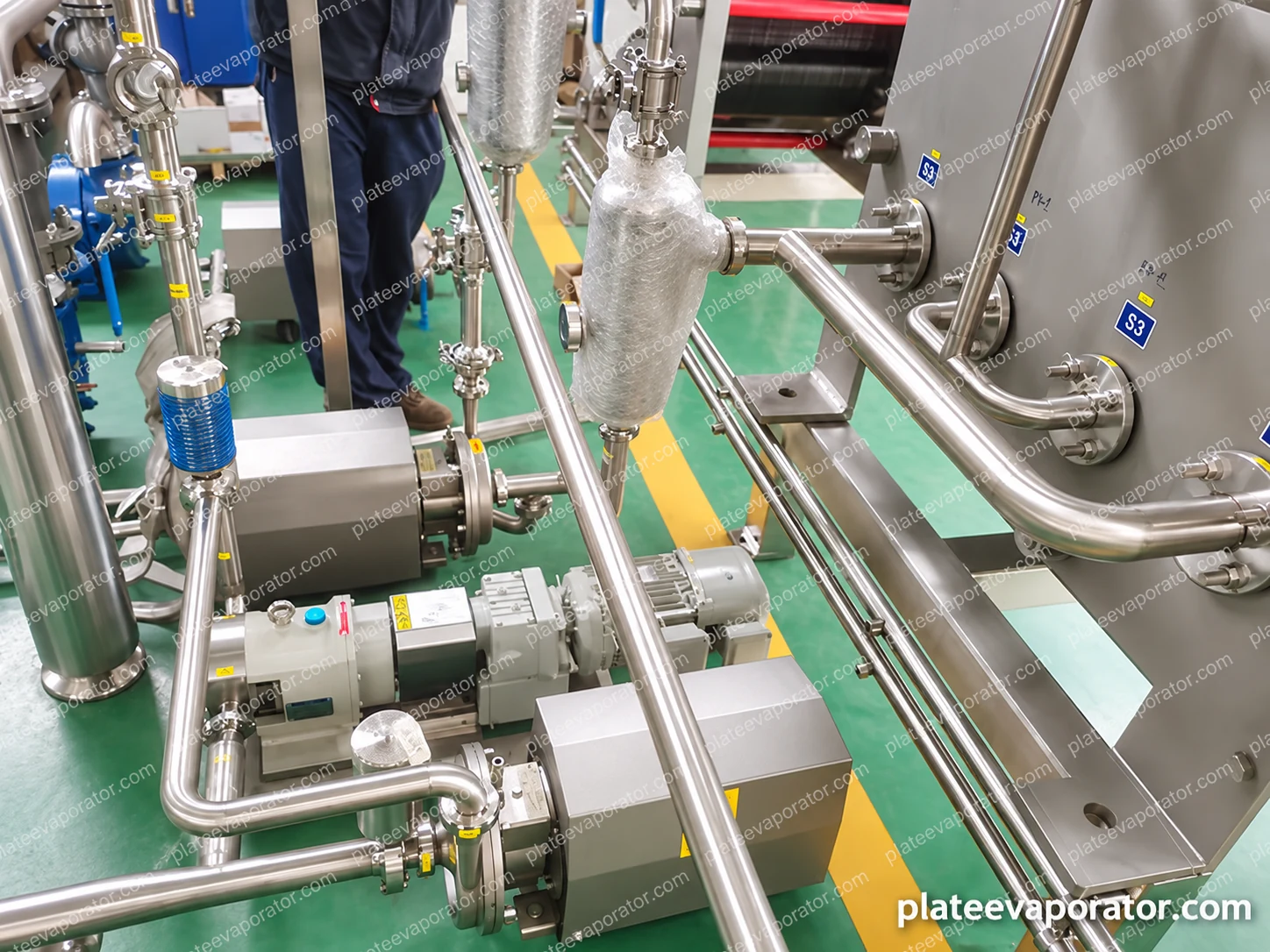
An external photograph of a clamped plate pack or a tall vessel does not identify the internal flow arrangement. Use the process drawing, operating description and equipment specification for the system being offered.
The list is a selection framework, not a claim that every arrangement is available in every plate system. The offered configuration and its process design govern the supply.
| Arrangement | Typical selection reason | What to verify |
|---|---|---|
| Falling film | Low-viscosity liquids and short residence time | Distribution, wetting, turndown and fouling |
| Rising film | Flooded heating surface and a different residence pattern | Liquid inventory, boiling behaviour and separation |
| Forced circulation | More viscous or depositing liquids where a film is unsuitable | Pumping duty, residence time, energy and cleaning |
Prepare the feed and define what the test must represent
Screening, clarification, filtration or phase separation can remove material that would block passages or promote deposits. The right preparation follows the actual feed. A separator that suits coconut water is not automatically required for a clear juice or a dairy stream.
For a representative trial, provide a sample from normal production, not a specially clean laboratory batch. Record composition, viscosity across the concentration range, particle size and shape, pulp or settleable solids, foaming, pH and cleaning behaviour. The trial should reach the intended outlet concentration under recorded temperature and vacuum conditions.
- Feed source, preparation and variability.
- Viscosity at inlet and outlet conditions, with method and shear basis.
- Particle size distribution, fibres, pulp and abrasives.
- Foaming, oil or fat, and deposit tendency.
- Target concentration, temperature limit and cleaning route.
When plate evaporation may not be the first choice
A plate evaporator is not the default answer for every concentration duty. Substantial pulp or long fibres, large or abrasive particles, very high viscosity, heavy deposition or a feed that cannot be kept distributed may favor another heat-transfer or circulation arrangement.
The comparison should use the same product and outlet target. A tubular, scraped-surface or forced-circulation system may have different residence time, cleanability and capital scope. The purpose of the comparison is to find a workable duty, not to force the liquid through the wrong passage.
Questions that make a supplier's answer specific
A useful answer identifies the data, the arrangement and the test condition. A single statement that the equipment is "suitable for viscous liquids" does not establish performance for a named product and outlet.
- Which flow arrangement is proposed, and how is the liquid distributed?
- What viscosity and particle data were used, at which concentration and temperature?
- What happens at the target concentration, not only at the feed?
- What is the cleanable path, and how is the plate pack inspected?
- Which trial or acceptance run will demonstrate the duty?
Further detail
Questions about the equipment
Is there a maximum viscosity for a plate evaporator?
No single figure applies across plate geometries and flow arrangements. Viscosity affects distribution, wetting, pumping and heat transfer, and it changes with concentration and temperature. Provide representative viscosity data across the full range and let the selected arrangement be assessed against it.
Can a plate evaporator handle pulp or particles?
It depends on particle size, shape, concentration, passage design and distribution. Small quantities of solids may be manageable in a suitably prepared feed; substantial pulp, long fibres or large abrasive particles can favor another arrangement. A representative sample and a defined feed specification are needed before making a commitment.
Does a falling-film plate evaporator suit viscous products?
Falling-film arrangements depend on complete wetting of the heating surface. Higher viscosity can reduce wetting and heat transfer, so a different distribution or circulation arrangement may be more appropriate. The assessment uses the actual viscosity curve and target concentration, not a generic category.
Can I test my liquid before buying?
A representative product trial can be agreed where the duty is uncertain. It should use production-representative feed and reach the intended concentration under recorded conditions. The trial scope, sample quantity, measurements and scale-up basis should be defined before the run.